Clive the G.O.A.T.
The spotlight never fades on Taylor Swift. But while she remains #1, memoirs and autobiographies from other musicians spring up like clover. The Rolling Stones’ Keith Richards has penned an autobiography titled “Life.” Frontman Bono in the rock band U2 wrote a memoir in 2022, “Surrender: 40 Songs, One Story.” Bruce Springsteen has come out with “Born to Run” and Rush’s lead vocalist Geddy Lee has written “My Effin’ Life.” The late Marianne Faithfull wrote both an autobiography and a memoir. Since these songwriters are getting published, I figure someone must be reading their stuff. I have in front of me on my desk a 2007 copy of The Heroin Diaries, a drug-addled, red-ink-splattered chronicle of glorious misadventure by songwriter Nikki Sixx of the legendary heavy metal band Mötley Crüe. Even on Broadway, the play “Stereophonic,” a study of a 1970’s rock band and its struggles in the studio, landed rave reviews. Clearly, the glamorous, cantankerous lives of musicians are as hot a topic today as when the Beatles ran into Marylebone Station in London in 1964 to escape screaming fans in the film A Hard Day’s Night.
Managing the Swedish rap duo realPfft, I meet Clive Flatenbad and Mutte Fjutt almost daily online over Microsoft Teams. Sitting at my laptop, seeing them in living color, the only two things separating Oxburg, Maryland from Uppsala, Sweden are a six-hour time difference and the Atlantic Ocean. Since he is eminently available and sure to please, I’m inclined to publish this interview with rap artist and lead singer Clive. I work with the dude, so I knew a lot of his backstory, but nothing like this. It feels like a college tutorial.
Born to a Swedish father and a British mum, Clive was raised in Stockholm. I consider him more than a musician. A performance artist, I think of him as G.O.A.T., the Greatest Of All Time frontman for Swedish garage bands. He sang in several back in the 1980’s, a time when thousands of wannabe rock stars dressed themselves in black leather, holed up in suburban basements and strummed guitars. When they weren’t out practicing ice hockey on frozen tennis courts, the boys were at home jamming.
Unlike John Lennon, Mick Jagger and Aerosmith’s Steven Tyler, Clive didn’t start out in music. He became a radio disc jockey while attending college in the United States in the 1970’s. Armed with a Radio Telephone Third Class Operator Permit from the FCC, he frog-marched into a local radio station that smelled like a cigar box and created radio theater. Clowning on a one-hour show, he christened it Audiographics. A clever name, it was graphic audio. Basically, it was a series of humorous podcasts 50 years before there was such a thing as podcasts. Filled with the conflicting personalities of American AM Top 40 radio, it offered mayhem on AM. (“Typing by Radio” was a recurring gag, where Clive supposedly taught touch-typing, clack, clack, clack, over the radio.) Whether intoning a British accent à la Winston Churchill, pr-pr-producing a nasal stutter or delivering the pear-shaped, mellifluous tones of a studio announcer, Clive invented a closetful of voices.
When he got back home to Stockholm, he worked on the railroad and freelanced as a rock journalist. One fine day, his buddy from high school Björn Svensson invited him to join his radio program. Once again, Clive’s many personae fit the bill. “We were pre-recording weekly half-hour radio shows in 100% Swedish that were broadcast at 11:30 on Tuesday nights, ‘Channel U R, Underground Radio,’” Clive explains. “Audio theater that made us into heroes fashioning something fresh in 1979 on the newly-created Stockholm Neighborhood Radio, set up by the government to compete with an off-shore commercial satellite radio station broadcasting in Swedish but based in Great Britain. Accustomed to having complete control of the airwaves, the Social Democrats didn’t like foreign interference one bit.”
It was an easy step from announcing to singing, from drama to drama queen.
What motivated you to become a singer?
“Sex. When it comes to sex, Americans think Sweden is some sort of bunny patch. In questions of intimacy, the law puts all the power in the hands of strong-willed Swedish women. One result is hundreds of thousands of blue-eyed blonde teenage schoolgirls giving you hard, sexually demanding stares. You cannot touch them, the law against pedophilia is super-strict. We’re the adults in the room. That doesn’t stop them from flirting outrageously. They all want to hang out with a singer in a band, just as long as he keeps his hands to himself. If you like to flirt, Sweden is Heaven on Earth.
“I have had to explain this rule of thumb to some genuine international rock stars playing concerts in Sweden during their European tours. ‘If she’s over 18, you can bed her, but remember that she is in charge,’ I instruct them. ‘And when you are done, don’t abandon her to your roadie. Take her downstairs for coffee and buy her something nice in the hotel gift shop. Be a gentleman. That way, hopefully, she will never accuse you of rape.’”
So you became a rock star.
“I only got into the music end of things because of Björn’s radio show. You know, Björn as in Björn Borg, but not. He needed songs tailor-made to fit the dialogue. I can sing. He bought a used, monophonic ARP synthesizer and a programmable electronic drum machine. Zowie! Overnight, we became a synth band.
“Since he wasn’t any good as a musician, Björn made up for a lack of chops by going hog wild on personality. Grimacing, sweating and growling in ecstasy, he pressed a single pale finger against a single white key on the keyboard of the pre-programmed synthesizer.
“Björn collected strays, whose unhappy presence occasionally made difficulties im das home studio. One of them, a starchy German audio engineer named Willy, wanted to know how you harmonized melodies when the monophonic synth only played one chord at a time. The short answer was, you didn’t. When multi-tracking, you could add individual chords one atop another, so-called layering, but an early synth was no Hammond organ or even a piano. It made one tone and only one tone at any given moment.
“One day, a piano player named Stefan sat down at the keyboard of the ARP and let loose a humongous parade of lickety-split chords in quick progression. ‘Aha,’ complained Björn dismissively, ‘one of those keyboardists. A plinky, planky, plonky piano player.’
“It was hard to counter Björn’s hard-edged critique, because if one expressed admiration for the pianist’s virtuoso abilities, it meant Björn was a gutless wonder, the hole in the doughnut. From that day on, Björn declared ‘I’m not a musician,’ making it sound like a vulgar label. ‘I’m a natural talent,’ he claimed. Since that is what he called himself, no criticism could be applied to his musical output because, after all, he wasn’t a musician composing music, he was a natural talent creating art.”
Whoa! That sounds like total bullshit.
“Back then, smoking a pack of cigarettes a day, I was all doped up on nicotine. Plus being jacked up on caffeine from umpteen mugs of coffee 24/7, a beverage known for its ergogenic and nootropic properties. Ugh!”
Come again?
“The result: I was a Dizzy Dan who couldn’t think straight. That meant Björn could sell me a load of goods. I had an inferiority complex after years of jeering abuse in grade school for being a British half-breed. Possessing low self-esteem, I accepted everything he dished out.
“While ABBA was raking in millions, Björn excused our lack of commercial success by endlessly chanting ‘One is never a prophet in his own land,’ a Jesus parable from the Bible.”
Sad, bro.
“I was mucho young and naïve.Since he was uninterested in piano lessons, Björn used the envelope function on the synthesizer to create a repetitive, fluctuating tone which he called ‘pulse music.’ Give the man credit, within a year or two, the boys in Düsseldorf, Germany christened the same musical style ‘techno’ and made it big in the dance clubs. We should have had a chunk of that, but a dilettante, Björn always found a reason not to go commercial.”
You’re pissing me off, Clive.
“Let’s remember, it was the 1980’s. Swedes had a social safety net the size of the moon and lots of disposable income. You really had to struggle to fail, but B.S. artist Björn and his cronies managed to so thoroughly blacken their reputations, they had to leave Stockholm with their tails between their legs. Declaring themselves a bohemian Artists’ Collective, they rented a farmhouse and took refuge on the island of Gotland.
“It was only a matter of time before Björn’s other buddy, yellow-haired, slow-eyed Anders, whose father is affiliated with the fish industry, arrived at the farmhouse one Spring morning. Living on the dole, guitar case and clunky red amplifier in hand, he acquired an extension cord, plugged it into an electrical outlet and fed the cord through an open window. Setting up his amplifier out of doors, facing the V in the wall where the chimney met the masonry, he tuned his candy apple red Stratocaster. Presto! Channeling Jimi Hendrix, Anders played improvised, endless guitar solos. Like, forty or fifty minutes at a time. Those musical interludes echoed for miles across the flat terrain of southern Gotland, waxing and waning ghost-like on the wind. Among the locals, no one knew where this strange guitar music was coming from. Like UFO’s, it was a mystery shrouded in uncertainty.
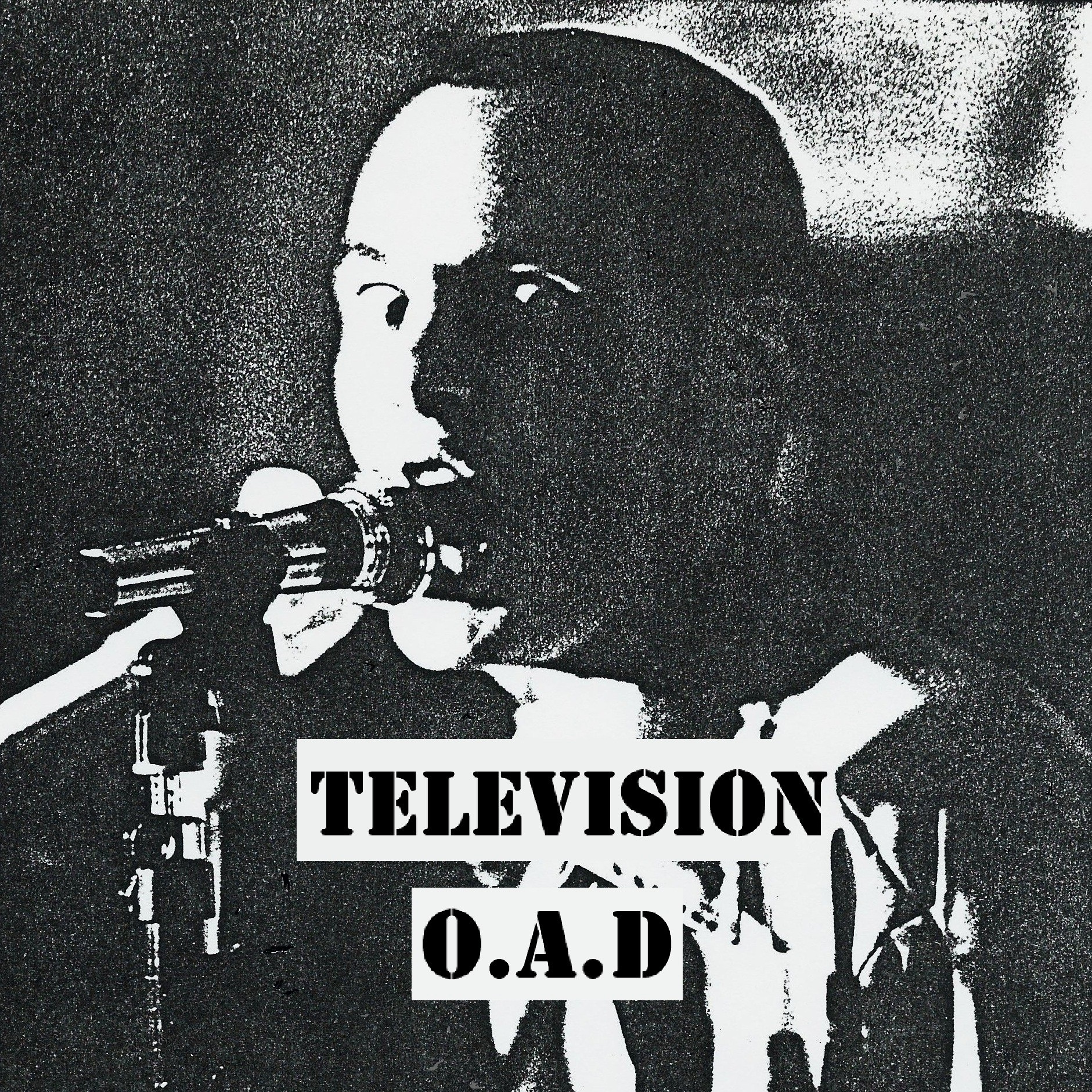
“The day came when southern Gotland held a rock festival. I was the lead singer in our punk band, O.A.D. Only After Death. Hetero-erotic melancholia, I got up on stage in a tattered Swedish Army uniform and growled in English:
Turn me on, turn me on, I’m a television
It’s your choice, make your decision
Turn the knob, hit the switch
Life changes in hue, death changes in pitch.
“Shazam! I knocked ’em dead. Going bonkers, the audience literally stormed the stage.”
So you were on your way?
“Southern Gotland is not exactly the center of the music universe. One good performance does not a career make. But, yeah, as a songwriter, I was a crowd-pleaser.
[Even Mutte Fjutt was involved with the band. He had a television repair shop in Uppsala where he upgraded and repaired the band’s equipment.]
“We rehearsed in the barn. Doing things the hard way, our studio equipment consisted of a used, 4-channel reel-to-reel tape recorder, only one step above a Blattnerphone.”
Never heard of it.
“Google it.
‘I need a guitar solo on every song,’ insisted Stratocaster Anders. ‘Otherwise, what’s the point of playing?’
‘What do you have in mind?’ I asked.
‘Forty-minute solos. Free form guitar improv is my specialty,’ he insisted.
‘We’re a synth band,’ countered Björn, adjusting knobs on the synthesizer before placing a ‘pie’ of dry snuff under his upper lip. ‘Our audience expects a synth solo in every song. One, at a minimum. More if need be. It’s expected.’
‘Actually, we’re a punk band,’ I pointed out.
‘Now you seem aggressive,’ scolded Björn, his fave critique. A Swede from the heartland, he bullied me constantly.
‘The bass guitar drives the rhythm section which is the motor in modern rock music,’ Max on bass mansplained. Mercifully, he didn’t demand a bass solo.
“Like the Beatles, we were a four-piece: Clive, Björn, Anders and Max. Trying to work with these rank amateurs, bathed in frustration, I found that their egomania quickly became a quagmire. It triggered in me almost daily meltdowns. Amid their endless gabbing, I had to beg them to shut up and play some music. Since I was a guest in their house, I was expected to play by their rules.”
Sounds like an ass backwards way to develop a career in pop music.
“Contacts, contacts, contacts, in Sweden it’s all a matter of who you know. A rock journo who doubled as a singer/songwriter, I got offers from record labels and professional musicians to front budding young teenage garage bands who, with the right frontman, could blossom into meaningful commercial vehicles. It happened all the time, singers went from high school choir to heavy metal bands in Swedish Norrland. Did I want to make music a full-time commitment? I was manager of a county railway station on the mainland. Wise, for once, I didn’t throw away my career at a moment’s notice.
“Björn peppered me with bad advice. ‘Musically, we are a dynamic duo. I am your muse. Without me, you are No-wheres-ville. No one has ever created music like ours!’
(Because it stinks, I thought.)
‘Our music will overthrow the music industry! No one will ever catch up with us.’
(I doubt it, I reasoned, keeping my own counsel.)
‘Our music isn’t commercial pap. We are creative geniuses. We refuse to sell out.’
(So the Beatles, Michael Jackson and the Stones have sold out to the man?)
‘This is our time! Why live a life of regret over what could have been? Never in the history of human progress has such a divine opportunity been spilled onto the laps of such worthy practitioners.’
(Maybe, but in that case, why does our music stink?)
‘I create soundscapes. It’s what I do. You should be eternally grateful that I am willing to share them with you.’
(Don’t do me any favors!)
‘I’ll be your manager. We’ll sign a contract. You can pay me by the hour.’
(Aha! Björn the money suck!)
“I discussed it with my dad, who was a personnel director in the government.
‘What’s the question?’ he asked, askance. ‘Give up a lifetime career and a pension for a stint as a singer in a rock band that only stays popular for three years? No way! What kind of lunacy is that? Sure, if you strike it rich and become an ABBA or the Beatles, but even then you are striking a deal with the devil. Money, money, money, get your head together!’
“By then, I owned three tape recorders, a mixing console, a MOSFET sound system, studio and stage speakers, microphones, reams of recording tape, a studio video camera and a U-matic video tape recorder. While I worked overtime on the railroad, my bandmates were on the island of Gotland, playing the hell out of my equipment. Me mum wanted to know who was footing the bill for all this creative tomfoolery. I was!
“Smart for once, I kept my full-time job.”
So that was the end of sex, drugs, rock and roll?
“That wasn’t my vibe. I had already done the whole drug scene in college, smoking Mary Jane and Mexican hashish to the point of confusion. Who wants to muddle through life in a daze? Then, too, I was a recovering alcoholic with visible liver damage on the X-rays. In a land of drunks, I became a teetotaler. Fed up with wild, meaningless sex, I became a monk, ruling out a host of sexually transmittable diseases. Hey, Mutte and I are still around and reasonably healthy. Take care of your bod, it’s the only one you’ve got.”
Fast forward. What’s cooking?
“Let’s be clear, Mutte and I barely make a red pfennig from our music. I don’t intend to travel under the false pretense that we are a commercial money-maker or a cash cow. Living on our pensions, music has become our hobby. It keeps us young. If Billboard ever releases The Top 2,000, you might find one of our tracks at #1,998. Yes, you will find us on TikTok, but since we don’t record TikTok videos, our audience is in the double digits. After eight years and 145 songs, our YouTube channel has eight subscribers. Eight! Tell your friends to subscribe!!!”
Hey! Let’s get realPfft’s YouTube Channel audience out of the single digits ditch, folks! It doesn’t cost anything, so SUBSCRIBE today!
“We belong to a musical rights organization that sends us royalty payments four times a year. It’s barely enough income to file it on our tax returns.
“When I read that Beyoncé and Taylor Swift are billionaires, it feels like we must be doing something mucho wrong-o, but Mutte and I are who we are. Our music distributor expects us, not them, to create a following on social media. We discussed it and that ain’t gonna happen. ‘Whatever time and energy we have, let’s concentrate on producing music,’ we decided.
“The paradox of social media is that if no one sends me a text message and my phone doesn’t ring, it often feels like no one knows I exist. I end up sitting alone at home, staring out the window at acres and acres of snow.”
Your listeners are in the single digits, but they come from cities as diverse as Toronto, Bogotá, Prague, Kuala Lumpur and Johannesburg.
“Our listeners are the bright spot in our lives! Alphabetically, they’re from Australia, Bahrain, Bangladesh, Belize, Canada, China, Colombia, Czech Republic, France, India, Indonesia, Japan, Luxembourg, Malaysia, Netherlands, Nigeria, Peru, Poland, Singapore, South Africa, Sweden, Thailand, UK, United Arab Emirates, USA and Vietnam.
“It’s an uphill struggle to chart in the UK, France or Japan since those markets focus on homegrown product, but we are there! Every time a fan downloads a free music file, that confirms for us that we are reaching our audience. We love the fact that our kookiest songs elicit the biggest response: Storming the Capitol, Back in the Pandemic, Speed Hump, My Broken Tooth, the funkadelic Timewarp. We often wonder how we come up with these songs, but as long as people like them, we’ll keep on ‘grinding out the hits.’
“Musical dinosaurs, Mutte and I love almost every kind of music: rock, pop, punk, rap, hip hop, soul, R & B, dance, disco, jazz, funk, fusion, metal, samba, salsa, calypso, steel drum, folk, chanson and classical. We call our genre Dino Pop.
“No klezmer, no polkas and no accordions, thanks.
“We once tried to release a K-Pop track, but our music distributor refused because we are not Korean. Wrong nationality, wrong generation.
LOL!
“Historically, music groups were at the mercy of their record labels. Record companies hired flacks who seldom understood the music or their groups. A & R dudes—Artist & Repertoire— decided what got released and when, what it sounded like, the cover art, how many copies went into the pressing and the size of the PR budget. Often, they made innocuous decisions that drove the recording artists mad.
“This unhappy situation has been passed down to today’s music distributors, who mean well but often seem clueless regarding trends, styles and technological breakthroughs. Online stores have all these irritating rules about track title formatting, capitalization, cover art content, explicit lyrics, metadata, copyrights and release dates. The music distributors ride herd on a stable of unruly, angry artists and have to right the ship according to the demands of the online stores. Now they have forbidden ‘sound alike’ covers of popular tunes, after customers complained that they had been hoodwinked into buying a track created by a tribute band instead of the original recording. Yada, yada, yada. If iTunes doesn’t like some facet of a music release, everyone falls into line, bending over backwards to satisfy iTunes. Nitpicky and hyper-focused, the online stores have all the authority.
“In the 1980’s, cassette tape became the primary format. You were no longer dependent on record companies, you could distribute your band’s music on a mixtape. The trade magazines published articles like ‘Will Home Taping Mean the Demise of the Record Industry?’
“Came the 1990’s, we got music CD’s, compact discs that you could burn on your computer. Hoo boy! Once arrogant record labels became as sweet as lambs. After firing half their staff, deeply solicitous, concerned about the welfare of their musical talent, they asked, ‘Do you need studio time? Do ya wanna cut a track? ‘Cause we can fix you up with an audio engineer and a producer if you have any jangly tunes circulating inside that head of yours.’
“Yesterday, DIY, you could take a computer, a guitar, a microphone, an interface and digital software and join the millions of musicians who were recording tracks in their bedrooms and releasing them online. Record labels were dead. After living through the age of vinyl, cassettes, CD’s and streaming, now we’re into A.I.
“I’m going bananas!”
I hear echoes of that craziness in your music.
“I like to say ‘Everything we do is comedy.’ realPfft means ‘really nothing.’ Lint. Let’s hear it for low self-esteem, dudes!
“Paul the perfectionist drove the other Beatles to distraction. More than one monumental rock band is known for huge fights in the studio. Aware of that, Mutte and I are super-careful not to stamp on each other’s toes. We are both clinical depressives, we can go into a blue funk and not compose a single note for months. Many is the time Mutte has composed instrumentals while waiting for Clive to get his sorry ass in front of a microphone. Besides being a music loops genius, Mutte is a great guy, very low-key. I’m a conspicuously live wire, a manic-depressive, so I try to tone down my assertive personality and let Mutte find his groove. Most often, he composes the music while I write the lyrics. Then we meet at the mixing console.
“We only release music that speaks to us, which means we are always going to inhabit the margins. Making a virtue of necessity, we try to breathe fresh creativity into mainstream pop’s cluttered soundscape. Time will tell whether we accumulate more gray hairs than fans!
“Prezident Ozymandias, we started out by making fun of Donald Trump, only to discover that he didn’t need us, he was pretty good at parodying himself. We stopped making fun of Trump because everyone is talking and no one is listening. ‘He’s crazy!’ or ‘He’s not crazy!’ It got old. Who cares? Alternative fact, me mum used to complain that ‘Trump is a real nothing burger.’ Mercifully, unlike MAGA, we are not fueled by insecurity and grievance. Yes, we are driven, but only by our quest for musical perfection. Our motto is ‘With realPfft in Modern Times,’ a take-off on King Carl Gustaf’s motto ‘For Sweden in Modern Times.’
“Fruity loops, Mutte has purchased some wonderful performances by female vocalists from Ghosthack in Germany. We love the fact that the same female vocal can appear in different tracks by separate bands in different countries. Anyone can buy those vocals. You can build a playlist showing how different musicians have used the identical material. Cool! Unfortunately, it drives music distributors nuts to find identical metadata spread across the globe. ‘Someone has stolen your vocal!’ warns the distributor. Well… no, not really. It’s called sharing. Loops also play havoc with copyright law, but the license to use the material is included in the purchase price.
“Everything changed with the arrival of TTS, Text-To-Speech, and now A.I.
“The music industry has a problem with artificial intelligence. The Internet is flooded with ghost artists and songs created by generative A.I. The tools have taken over the workshop! We’re in the age of push-button songwriting, anyone can dial up a song.
“In the Old Days— two years ago— Mutte used ChatGPT to produce song lyrics which he fed into the Text-To-Speech platform Uberduck and hit ‘rap.’ Uberduck provided a rapper style voice and rhythm, which Mutte fed into Suno AI which combined the vocal with an instrumental accompaniment, producing a finished track. Cut and paste music.
“Today, Mutte might feel inspired to feed a prompt into Google’s Gemini AI, ‘Write me a song about the Stockholm sewer system.’ Gemini delivers song lyrics which Mutte feeds into Riffusion/Producer.ai, a tool which creates the voice, style, rhythm, melody and rock accompaniment. Riffusion has combined these various functions, everything from soup to nuts, on a single platform. Voila! A finished track: trip-hop, IDM, Swedish house music.
“We spend a lot of time at the mixing console. Music created from electronic signals is brittle and a bear to mix. There are hi-fi and mastering issues. Still, a Brave New World, computer programs often provide our next hit song. If we don’t like the first version, we can always ask the software for a remix.
“Kuny, who does our cover artwork, feeds a prompt into Microsoft Copilot and within minutes, he has a png file containing finished cover art that used to take him days to create.
“Riding the crest of this wave, the joke is on us. The music industry talks about ‘A.I. junk’ and ‘A.I. generated noise’ on the Internet muscling out bona fide artists. Fake bands like The Velvet Sundown can attract millions of fans, their creators milking thousands of dollars in royalty payments from the industry. According to Google, current data suggests that over 30,000 A.I. generated tracks are uploaded daily to the streaming platform Deezer. That’s hundreds of thousands of songs every week.
“The figures are mind-boggling. Totally nerts. The generative A.I. website Boomy claims it has generated over 22 million songs or 15% of the world’s recorded music.
Are you afraid of being replaced by A.I.?
“Thank God realPfft released its first track in 2018. We have bona fides, we’re not an imaginary band. I love the idea of Wall-E rolling onstage at a music festival, approaching a microphone and singing its little heart out. That would be interesting music! Alvin and the Chipmunks meet Silicon Valley.
“Using A.I. as a tool, Mutte and I have become adept music producers, but we risk losing our souls. Retired, older and hopefully wiser, our creativity is a race against the clock.
“We’re big in China! And Swedish Pop is now a specific genre on Spotify.”
Are you going to do a Taylor Swift and re-record gems from your back catalog? The song Television was first recorded in 1981.
“You have a typical businessman mentality, Kevin. Let me ask Mutte and get back to you.”
Cool beans, Clive! Cool beans.
Note: Some personal names and references have been fictionalized to protect people’s privacy.


Recent Comments